


Dxpert explores AI investing, from semiconductors and cloud infrastructure to valuations, risks and the key drivers shaping AI stocks.

AI Investing: Understanding the Opportunities, Risks, and Key Market Drivers
By Andreas Thalassinos, Head of Trading Insights at Dxpert
Artificial intelligence could transform entire industries, but that does not mean every AI-related stock will become a successful investment.
As companies spend more on semiconductors, cloud infrastructure, data centers, and AI-powered services, investors are gaining new ways to participate in the growth of the technology.
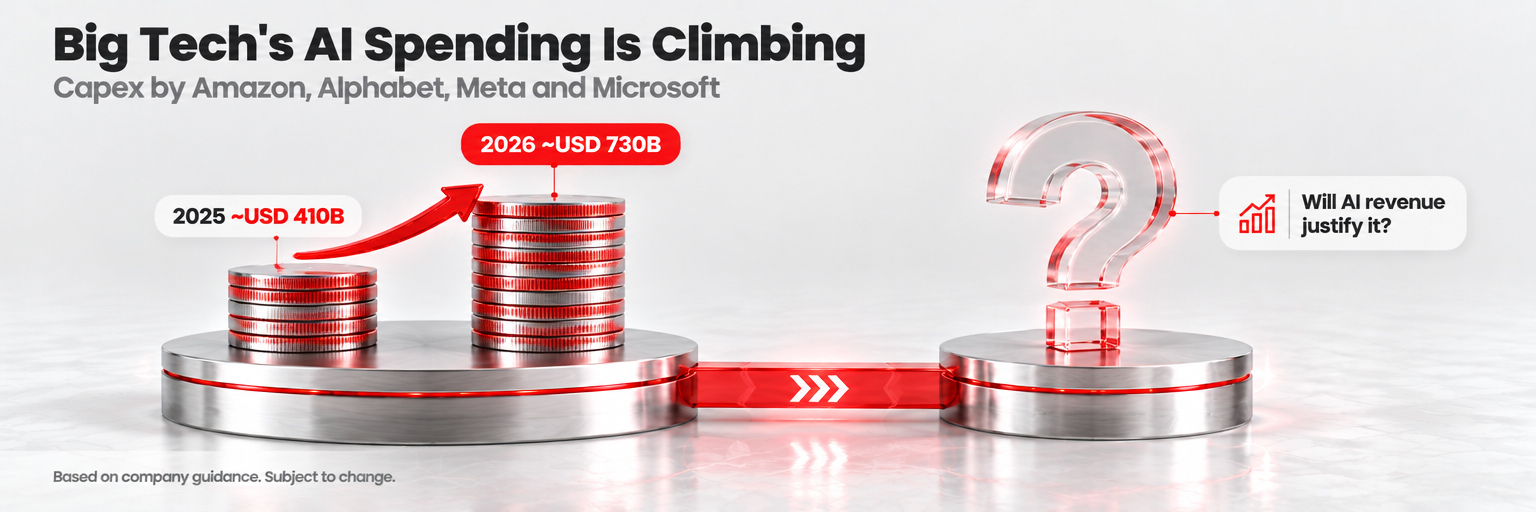
The scale of that spending is striking. Amazon, Alphabet, Meta, and Microsoft are together on track to spend roughly USD 730 billion on capital expenditure in 2026, up from about USD 410 billion in 2025, with most of it directed at AI infrastructure.
At the same time, rising valuations, heavy infrastructure spending, competition, and changing market expectations are creating new risks.
A company can successfully use AI to improve its business and still see its share price fall if costs rise, earnings disappoint, or investors have already priced in aggressive future growth.
Understanding AI investing therefore requires looking beyond the technology itself. Investors need to consider where companies sit within the AI ecosystem, whether growth is translating into stronger financial results, and what risks could affect future returns.
1. Understanding the AI Investment Ecosystem
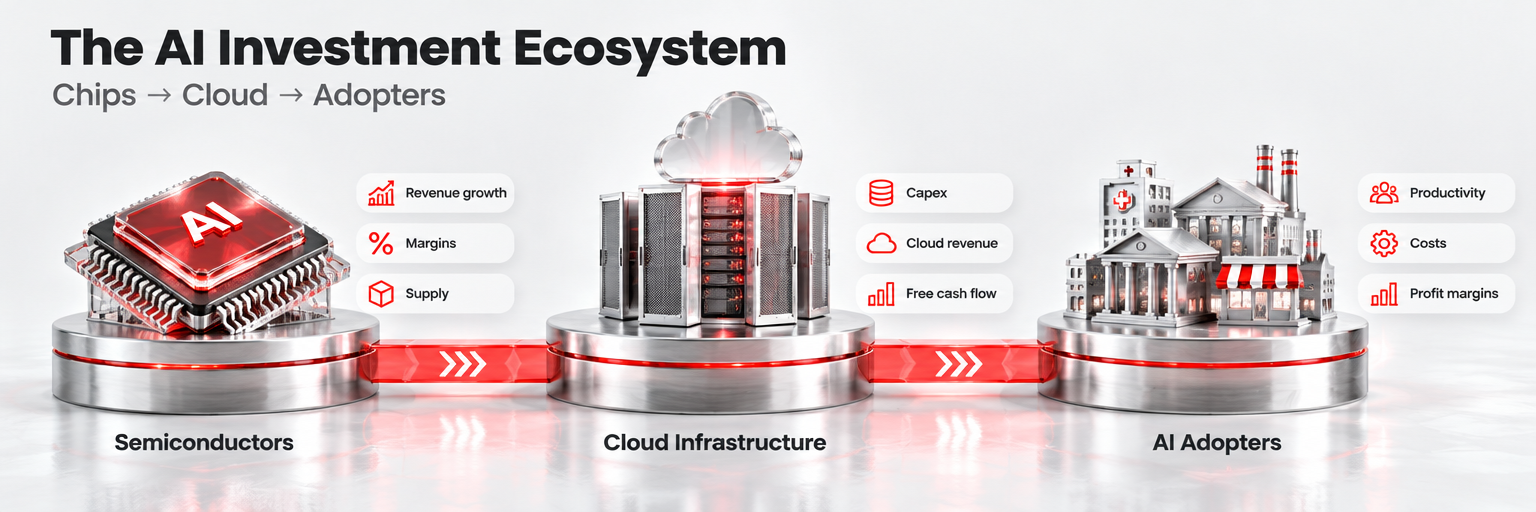
AI investing extends well beyond companies developing AI software. The broader ecosystem includes businesses supplying the chips, computing infrastructure, and services that allow AI to operate, as well as companies using AI to improve existing businesses. Three areas are particularly important.
Semiconductors: Powering AI Growth
Semiconductors are the foundation of modern AI systems. Training advanced AI models and processing large amounts of data require specialized chips capable of performing complex calculations efficiently.
Companies such as NVIDIA and AMD develop processors used in AI computing, while firms such as Taiwan Semiconductor Manufacturing Company (TSMC) manufacture advanced chips for technology companies.
As demand for AI computing increases, semiconductor companies and their suppliers stand to benefit. However, stronger industry demand does not automatically guarantee stronger investment returns.
Investors can monitor:
- Revenue growth: Is rising AI demand translating into stronger sales?
- Profit margins: Can companies maintain profitability as competition increases?
- Supply constraints: Could manufacturing limitations affect production or deliveries?
- Valuations: Have expectations for future growth already been reflected in share prices?
Semiconductor stocks are also influenced by shifts in technology spending, global trade policies, supply chains, and broader economic conditions.
Cloud Infrastructure: Building the AI Backbone
The second major part of the AI ecosystem is cloud computing and data center infrastructure. AI requires significant computing power, data storage, and network capacity, and cloud providers allow companies to access these resources without building all of the infrastructure themselves.
Microsoft, Amazon, and Alphabet operate some of the world’s largest cloud platforms and continue to expand their AI-related services and infrastructure. These businesses can benefit as more companies adopt AI and require additional computing capacity.
But expansion comes at a cost. Building data centers, purchasing advanced chips, expanding networks, and securing sufficient electricity require substantial capital investment.
In mid-2026, Amazon raised its full-year capital expenditure guidance to around USD 220 billion, citing higher memory chip prices, while Alphabet lifted its range to USD 195 billion to USD 205 billion.
This creates an important question for investors:
Will rising AI revenue be enough to justify the scale of AI infrastructure spending?
Higher capital expenditure can support long-term growth, but it also puts pressure on free cash flow and profitability in the shorter term. That makes the relationship between AI spending and financial returns increasingly important.
AI Adoption: Opportunities Beyond Technology
AI investment opportunities are not limited to technology companies. Businesses across many industries are integrating AI into existing operations, often with the goal of improving productivity, reducing costs, or creating new revenue opportunities. Examples include:
- Healthcare: AI can support medical imaging, research, diagnostics, and administrative processes.
- Financial services: Banks and financial institutions can use AI for fraud detection, risk assessment, and customer support.
- Manufacturing: AI-based systems can improve production efficiency and predictive maintenance.
- Retail: Companies can use AI to improve inventory management, demand forecasting, and customer experiences.
For these businesses, the investment case depends less on simply adopting AI and more on whether the technology creates measurable financial improvements. Investors can therefore look at whether AI helps companies increase margins, reduce costs, improve productivity, or generate sustainable revenue growth.
2. Why AI Stock Valuations Matter
One of the most important factors in AI investing is valuation. A company can have a strong product, rising demand, and impressive revenue growth, yet still become a risky investment if its share price already reflects extremely optimistic expectations.
Growth Versus Expectations
Consider a hypothetical example. Company A develops AI processors and reports annual revenue growth of 40%. At first glance, that appears strong. But if investors had expected growth of 60%, the stock could still fall despite the company delivering substantial growth.
That illustrates an important market principle:
Stock prices react not only to financial results, but also to how those results compare with expectations.

This is especially relevant for AI-related companies, where valuations often already incorporate expectations of rapid future growth.
Key Metrics for Valuing AI Stocks
Investors often evaluate these companies using several financial measures:
- Price-to-Earnings (P/E) ratio: Compares a company’s share price with its earnings per share.
- Revenue growth: Measures how quickly the business is expanding.
- Profit margins: Show how efficiently the company converts revenue into profit.
- Free cash flow: Measures cash generated after capital expenditures.
- Forward earnings expectations: Reflect forecasts of future profitability.
These metrics help investors distinguish between businesses generating durable financial results and companies whose valuations depend heavily on future expectations. A strong AI story can attract investor attention, but eventually the financial results still need to support the valuation.
3. What Drives AI Stock Prices?
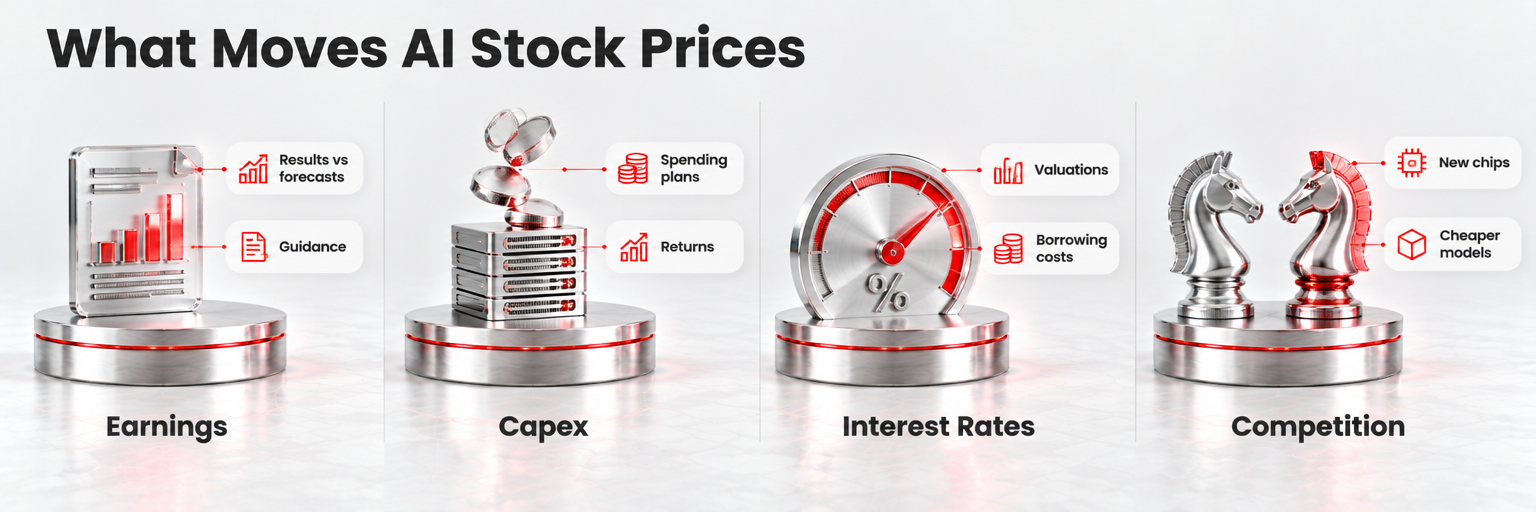
AI-related stocks are influenced by several forces beyond the growth of the technology itself.
Earnings, Capex, and AI Spending
Corporate earnings provide one of the clearest signals of whether AI demand is translating into business growth. Investors closely monitor semiconductor sales, cloud revenue, capital expenditure plans, profit margins, and management forecasts.
Better-than-expected results tend to strengthen market confidence. Disappointing earnings, weaker guidance, or higher-than-expected spending can have the opposite effect, particularly when valuations are already elevated.
The market’s reaction to mid-2026 earnings showed this clearly. When Amazon and Alphabet both raised their spending plans, Amazon’s shares rose while Alphabet’s fell. Investors were judging each company on whether it could turn that spending into returns, not on the size of the spending alone. As AI infrastructure investment continues to climb, that focus on measurable revenue and profitability is likely to sharpen.
Interest Rates and Monetary Policy
Interest rates also matter, particularly for fast-growing technology companies. When rates rise, the present value of expected future earnings declines, which can put pressure on equity valuations. Higher borrowing costs also make large infrastructure projects more expensive.
Lower interest rates can support growth-oriented stocks by reducing financing costs and improving valuation conditions, although the wider economic environment still matters. A lower-rate environment will not necessarily support AI stocks if economic growth or corporate earnings are deteriorating.
Markets also tend to move on where rates are expected to go, not only on the decisions themselves. We explore this in more detail in How Interest Rate Expectations Move Forex, Gold, and Indices, while How Central Banks Affect Gold, Forex and Stock Markets looks at how policy guidance and real yields feed through to stock indices.
Competition and Technological Change
AI is developing rapidly. New chips, competing AI models, advances in computing, and lower-cost technologies can quickly change which companies lead the market.
Businesses that dominate one part of the AI ecosystem today could face greater pressure if competitors introduce more efficient, cheaper, or more capable technologies. Innovation, pricing power, and sustainable competitive advantages are therefore important considerations when evaluating long-term AI opportunities.
4. The Risks of Investing in AI
AI offers significant long-term potential, but investing in the sector also comes with several risks.
Market and Valuation Risks
Valuation risk: High expectations can make AI-related stocks vulnerable to sharp corrections when earnings, revenue growth, or management forecasts disappoint.
Concentration risk: Major technology companies represent a significant share of several leading stock market indices. Weakness in a relatively small group of heavily weighted companies can therefore influence broader market performance.
Business and Execution Risks
Infrastructure and profitability risk: Large investments in data centers, computing equipment, and AI infrastructure can take years to generate sufficient financial returns.
Technological risk: Rapid innovation can shorten product lifecycles, intensify competition, and threaten existing business models.
Regulatory and Geopolitical Risks
Export restrictions, data protection rules, trade policies, and evolving AI regulations can affect operating costs, supply chains, and market access.
Diversification can help reduce concentration risk, but it cannot eliminate market risk or prevent losses.
5. Five Questions to Ask Before Investing in AI
Instead of focusing only on AI headlines or technological breakthroughs, traders and investors can take a broader approach when evaluating the sector.
The Five Questions
- 1. Is AI demand generating tangible revenue and earnings growth?
- 2, Are current stock valuations supported by realistic future expectations?
- 3. How much are companies spending on AI infrastructure, and what returns are they generating?
- 4. Could interest rates, competition, or regulatory developments affect future performance?
- 5. Is investment exposure concentrated in a small number of technology companies?
Short-Term Traders Versus Long-Term Investors
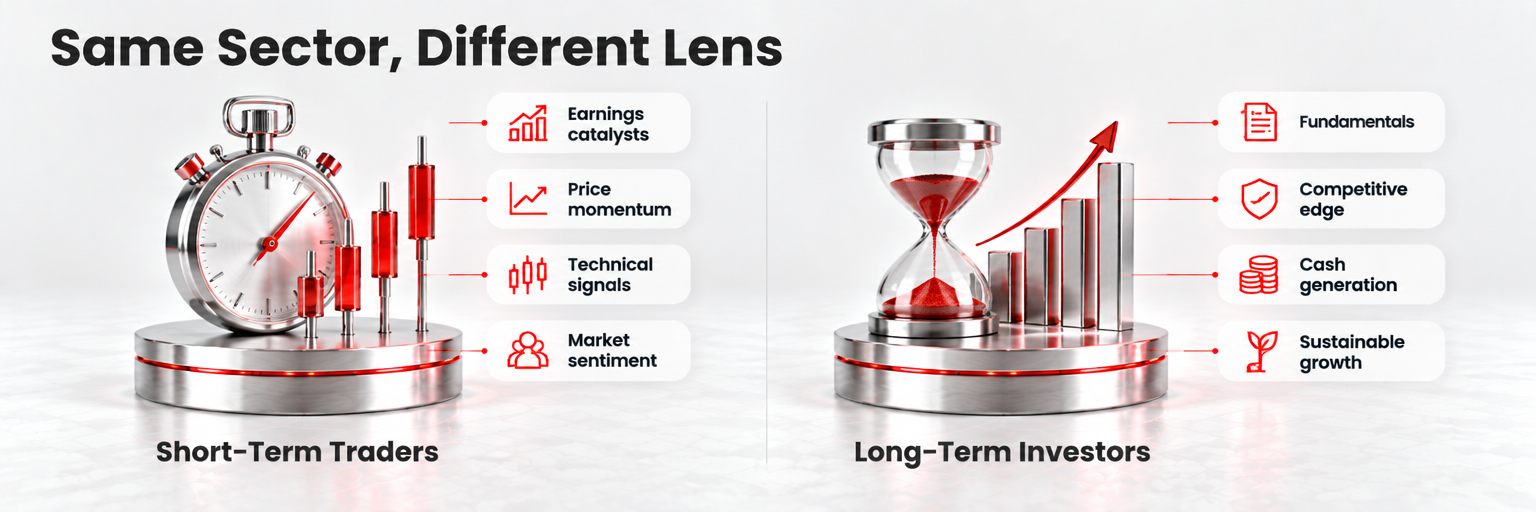
The importance of each question also depends on the investor’s time horizon.
Short-term traders tend to place greater emphasis on technical signals, earnings catalysts, price momentum, and market sentiment. Long-term investors usually focus more heavily on business fundamentals, competitive advantages, profitability, cash generation, and sustainable growth.
Both approaches still require careful risk management, particularly because expectations surrounding AI can change quickly.
Beyond the AI Hype
Artificial intelligence has the potential to transform industries and create significant economic opportunities. But understanding AI investing requires more than identifying companies associated with the technology.
Semiconductor manufacturers provide the computing power required for AI. Cloud infrastructure companies supply the computing capacity and services needed to scale it.
Businesses across healthcare, finance, manufacturing, retail, and other industries are adopting AI in an effort to improve operations and financial performance.
Each part of this ecosystem has different growth drivers, financial characteristics, and investment risks.
Most importantly, AI succeeding as a technology does not mean every AI-related investment will succeed.
Valuation, profitability, competition, interest rates, capital spending, and market expectations will continue to influence investment outcomes. As the AI landscape evolves, separating technological excitement from measurable financial performance can help traders and investors evaluate opportunities with greater perspective.
For traders, exposure to AI-related companies and technology-heavy indices is also available through contracts for difference (CFDs), which allow you to speculate on price movements in either direction without owning the underlying shares.
CFDs are leveraged products, so gains and losses are both magnified, and losses can exceed your initial expectations in fast-moving markets.
Stay informed with D Prime market insights as the AI investment landscape continues to evolve.
Disclaimer
Any views, opinions, analysis, forecasts or statements expressed or provided by third parties represent the personal views of the respective third parties and do not constitute or represent the views, opinion, recommendations, or official position of D Prime. D Prime does not verify, endorse, guarantee or accept responsibility for the accuracy, completeness, or reliability of such content.
The information contained herein is provided solely for general informational and educational purposes only and does not constitute investment advice, financial advice, trading advice or any other form of professional advice, a recommendation, or an offer or solicitation to buy or sell any financial instruments or engage in any trading strategy.
Trading in leveraged products such as contracts for difference (CFDs) involves a significant risk of loss and may not be suitable for all investors. Leverage can magnify both gains and losses, and investors may lose some or all of their invested capital. Past performance is not indicative of future results. Any references to market trends, asset performance, price levels, or forward-looking statements reflect opinions or general market commentary as at the date of publication and are subject to change without notice and may not materialize as anticipated.
This article does not take into account any individual investor’s objectives, financial situation, or risk tolerance. Readers should conduct their own independent research and seek professional advice before making any investment or trading decisions. D Prime and its affiliates make no representations or warranties about the accuracy or completeness or reliability of this information and disclaim any and all liability for any direct, indirect, incidental, consequential, or other losses or damages arising out of or in connection with the use of or reliance on any information contained herein. The above information should not be used or considered as the basis for any trading decisions or as an invitation to engage in any transaction. Do not rely on this article to replace your independent judgment.
“D Prime” is a brand name of D Prime Vanuatu Limited, a company incorporated and regulated by the Vanuatu Financial Services Commission (Company Number: 700238). The availability of products and services may vary depending on jurisdiction and applicable regulatory requirements.