

Learn how to calculate forex swap and spread costs, why Wednesday swap counts three times, and how D Prime’s Swap-Free Offer can lower overnight costs.
How to Calculate Forex Swap and Spread Costs (and Reduce Them)
You buy one standard lot of EUR/USD on Monday. By the following Monday (seven calendar days later), the market has moved 12 pips in your favour before trading costs, so you expect roughly USD 120.
Your result after costs: USD 66.50.
Nothing went wrong with the trade. Rather, two kinds of cost made the difference: the spread and commission you pay on every trade, and the swap, which can build up for every night you hold.
This guide shows you exactly where that USD 53.50 went, how to calculate both costs before you trade, why one rollover can count three times, and how to keep more of a favourable price move. You will use two formulas throughout:
Spread cost = spread in pips × pip value × lots
Swap = number of swap days × swap rate × number of lots × point value
All figures in the examples are hypothetical and for illustration only.
- What Is the Spread in Forex, and What Does It Cost You?
- What Is a Forex Swap, and Why Does It Grow Over Time?
- How to Calculate Forex Swap Step by Step
- Triple Swap: Why One Night Can Cost Three Times as Much
- Worked Example: Where Did the USD 53.50 Go?
- How to Reduce Forex Spread and Swap Costs
- Another Way to Reduce Overnight Costs: D Prime Swap-Free
- Frequently Asked Questions
What Is the Spread in Forex, and What Does It Cost You?
The spread is the difference between the bid price, where you can sell, and the ask price, where you can buy. Because the ask is higher than the bid, a new trade normally starts slightly in the red, so the spread is the first cost your trade needs to overcome.
How to Calculate Forex Spread in Pips and USD
Spread in pips = (ask price − bid price) ÷ pip size
For most currency pairs, one pip is 0.0001. For Japanese yen pairs, however, it is generally 0.01. To turn the spread into money, multiply it by the pip value and your position size. For EUR/USD, one pip on a standard lot of 100,000 units is approximately USD 10.
Suppose EUR/USD is quoted at 1.08520 bid and 1.08522 ask. The spread is 0.00002 ÷ 0.0001 = 0.2 pips, so one standard lot costs:
0.2 pips × USD 10 = USD 2
On an ECN account, commission is added on top: USD 3 per lot per side, or USD 6 to open and close. Together, that is the first USD 8 of the missing USD 53.50.
Why Your Spread Can Change
However, the spread itself is not fixed. Variable spreads are often tighter when trading activity is high and can widen when liquidity falls or volatility jumps, such as around major economic releases, central bank decisions, the daily rollover and public holidays.
In other words, when you trade can affect what you pay. Trading during more liquid periods can help you avoid some of the widest spreads, while before major news it is worth checking the Weekly Economic Calendar.
D Prime publishes spreads from 0.0 pips on ECN accounts and from 1 pip on STP accounts, although actual spreads vary by instrument, account and market conditions. For a full breakdown, see D Prime Trading Costs Explained: Spreads, Fees & Commissions.
Swap works differently: it keeps building for as long as a position stays open overnight.
What Is a Forex Swap, and Why Does It Grow Over Time?
If the spread is the entry cost, think of swap as the cost or credit of carrying a trade overnight. Also called rollover or overnight financing, it applies to positions still open at the daily rollover. In our opening example, it accounted for the remaining USD 45.50.
What Determines the Swap Rate?
Overnight financing is influenced by the interest rates of the two currencies in the pair, together with the broker’s pricing and financing arrangements.
The timing comes from settlement. Spot forex normally settles within two business days of the trade, known as T+2, so each rollover moves the settlement date forward and the swap reflects the financing for that extra time.
Long, Short, Positive and Negative Swaps
Each currency pair has separate swap rates for long and short positions, so a swap can be negative, meaning you are charged, or positive, meaning you receive a credit.
However, a positive swap is never guaranteed, since financing rates change. For your trade, the practical question is: how much will holding overnight add to or subtract from my result?
How to Calculate Forex Swap Step by Step
D Prime calculates overnight swap with this formula:
Swap = number of swap days × swap rate × number of lots × point value
The Swap Formula in Practice
For EUR/USD, a standard lot is 100,000 units. So if the swap is quoted in points and the point size is 0.00001, each point is worth 100,000 × 0.00001 = USD 1 per standard lot.
Now suppose you hold 2 lots of EUR/USD long for 3 normal swap days at a swap rate of −6.5 points. In that case:
3 × 6.5 × 2 × USD 1 = USD 39
If the rate were positive instead, the same calculation would give the amount credited. Either way, you can estimate the cost before you hold rather than discover it after you close.
How to Find Your Swap Rate in MT4 or MT5
You do not need to guess the swap rate. Simply open the symbol’s Specification window in MetaTrader 4 or MetaTrader 5, where you will see details such as the swap type, the long and short swap rates, and the triple swap day. Because rates change, check them before entering any position you expect to hold overnight.
But one detail can change the calculation significantly: one rollover each week may count as three days instead of one.
Triple Swap: Why One Night Can Cost Three Times as Much
Once a week, a position held over the triple swap rollover receives three days of financing in a single adjustment. For many forex pairs, this happens at the Wednesday rollover.
Why Triple Swap Happens
Remember T+2 settlement: each rollover moves the settlement date forward, and the swap covers the days it moves. Compare two nights in the same week:
- Tuesday’s rollover: settlement moves from Thursday to Friday, so 1 day is charged.
- Wednesday’s rollover: settlement moves from Friday to Monday, across the weekend, so 3 days are charged: Friday, Saturday and Sunday.
In other words, Wednesday’s triple swap is simply the weekend’s financing, charged midweek rather than an extra fee.
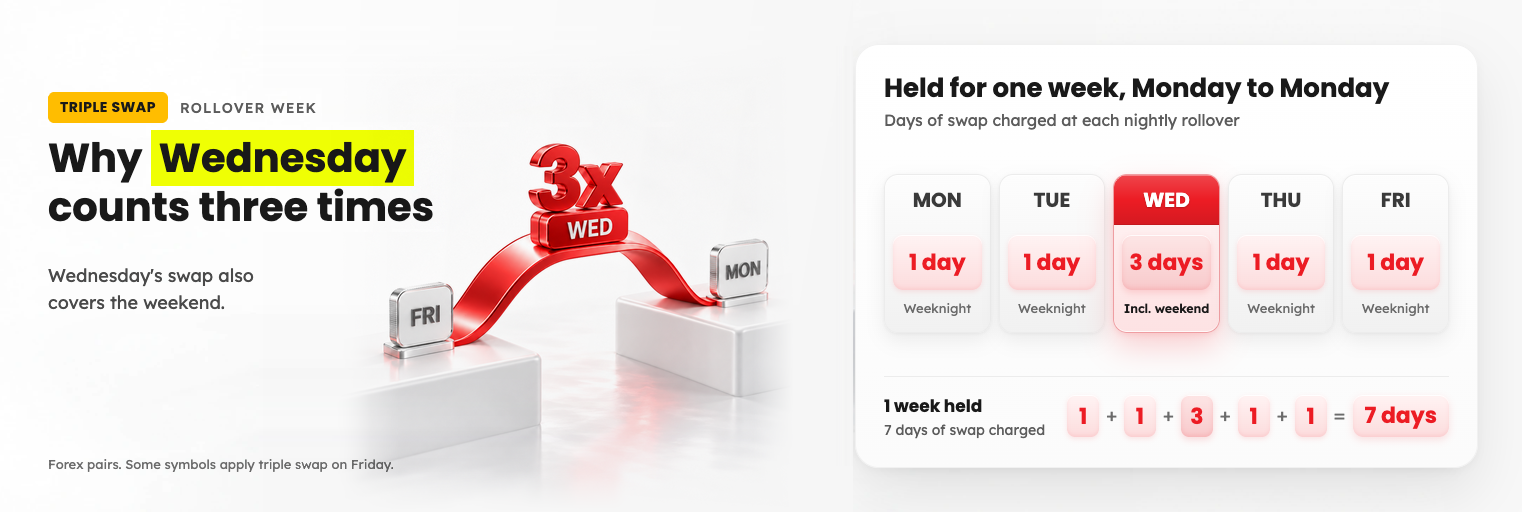
On D Prime, the triple swap is charged on Wednesday or Friday at 23:59 server time, depending on the symbol. For forex pairs, it applies to positions still open at 5pm New York time on Wednesday.
What Triple Swap Means for Your Trade
If your normal swap charge is USD 6.50 per day, a regular rollover costs USD 6.50, while a triple rollover costs USD 19.50. So before opening a swing trade, check not only how many nights you expect to hold it, but which nights.
Now we have all the pieces to solve the USD 53.50 question.
Worked Example: Where Did the USD 53.50 Go?
Return to the original trade and assume:
- Position: buy 1 standard lot EUR/USD
- Account: ECN, USD 3 commission per lot per side
- Spread: 0.2 pips
- Swap long: −6.5 points per swap day
- Holding period: Monday to the following Monday, closed before the next rollover
- Profit before costs: 12 pips, worth USD 120
Step 1: Spread and Commission
The 0.2 pip spread costs USD 2 and the commission to open and close costs USD 6, so before swap, the USD 120 profit becomes:
USD 120 − USD 8 = USD 112
Step 2: Swap Cost
The position stays open through five rollovers, and because one of them is a triple swap rollover, they add up to seven swap days, one for each night of the week. At USD 6.50 per swap day:
7 × USD 6.50 = USD 45.50
Step 3: Total Trading Cost
| Cost | Closed same day | Held 1 night | Held 1 week (5 rollovers) |
|---|---|---|---|
| Spread + commission | USD 8.00 | USD 8.00 | USD 8.00 |
| Swap days | 0 | 1 | 7 |
| Swap | USD 0.00 | USD 6.50 | USD 45.50 |
| Total cost | USD 8.00 | USD 14.50 | USD 53.50 |
| Equivalent cost in pips | 0.8 | 1.45 | 5.35 |
Now the opening result makes sense:
USD 120 − USD 53.50 in spread, commission and swap = USD 66.50
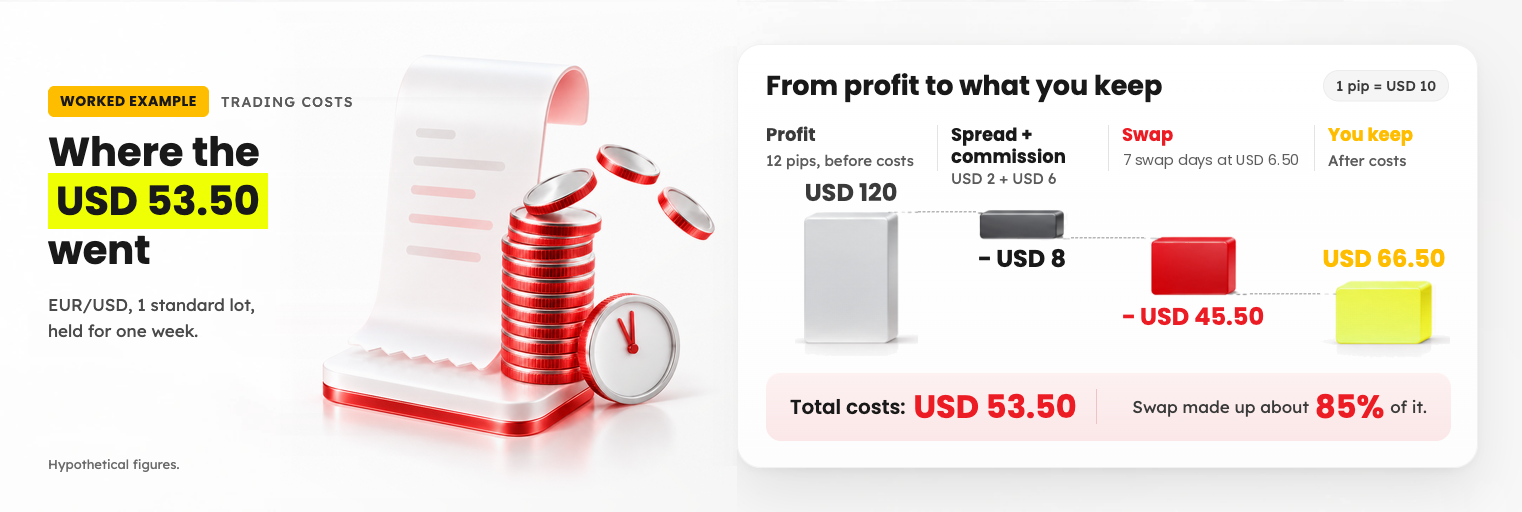
The important part, however, is how the cost changes over time. When the trade is closed on the same day, spread and commission are the whole cost, whereas by the end of the week swap represents USD 45.50 of the USD 53.50 total, or roughly 85%.
In short, the longer a trade stays open, the less the original USD 8 in spread and commission matters relative to overnight financing. That is why different trading styles need to think about costs differently.
How to Reduce Forex Spread and Swap Costs
No single approach works for every strategy, so start with one question: which cost matters most for the way you trade?
Choose Your Account Based on How You Trade
If you regularly open and close positions within the same day, swap may not be your main concern. Instead, focus on spread, commission, execution and your monthly trading volume, because small differences add up quickly. For example, a gap of just 0.3 pips across 100 standard lot round turns equals:
0.3 × USD 10 × 100 = USD 300
Therefore, compare the total cost per trade, including commission, rather than a raw spread in isolation. On D Prime, the ECN account charges a commission of USD 3 per lot per side (USD 6 per round turn), while the STP account has no separate commission. Our ECN vs STP Account Guide shows how to compare the two on cost per trade.
Check Swap Before It Eats Into Your Target
For swing and position trades, on the other hand, swap can matter much more. Before entering:
- 1. check the swap rate for your direction
- 2. then estimate how long you expect to hold
- 3. also include any triple swap rollover
- 4. finally, compare the estimated cost with your target
At the same USD 6.50 per swap day, fourteen swap days would cost USD 91, or 9.1 pips on one standard lot. So if your target is 30 pips, almost a third of it could go to financing before other costs are considered.
There is also another option: on eligible instruments and accounts, the swap itself may be reduced or removed.
Another Way to Reduce Overnight Costs: D Prime Swap-Free
Remember that USD 45.50 of the USD 53.50 cost in our example came from swap. If that position qualified for D Prime’s Swap-Free Offer, that overnight cost could be removed for a limited period, depending on your account type, the instrument and your country of residence. For traders who often hold positions overnight, that can change the cost picture considerably.
How D Prime Swap-Free Works
The promotion lists:
| Instrument group | Swap-free duration |
|---|---|
| Forex Majors, Forex Crosses and Forex Minors (excluding TRY pairs); Metals (including XAGUSD, excluding Special Metals); Oil and Natural Gas; Spot Indices | 7 trading days, or up to 14 trading days for VIP clients (on application) |
| Cryptocurrencies, Futures CFDs, Stock CFDs, TRY pairs and Special Metals | Not eligible |
Under the standard offer, the swap-free duration is the same across all eligible instruments, subject to regional restrictions. For eligible clients residing in China and Korea, the swap-free period is limited to 1 trading day. Both ECN and STP accounts are eligible, while Cent and ECN Cent accounts are excluded. Once the applicable swap-free period ends, standard swap charges apply. Swap-free duration and eligibility vary by account type, instrument and the client’s country of residence. Please refer to the latest Swap-Free Offer terms and conditions.
What Swap-Free Would Mean for Our EUR/USD Example
Under the Swap-Free Offer, eligible Forex Majors such as EUR/USD carry no swap for a limited period, depending on account type and country of residence. Our hypothetical trade stays open for five trading days, which is within the standard 7-trading-day period. So if the trade qualified for the offer and the entire holding period was covered by the applicable swap-free duration, the USD 45.50 swap charge would be removed and the result would become:
USD 120 − USD 8 spread and commission = USD 112
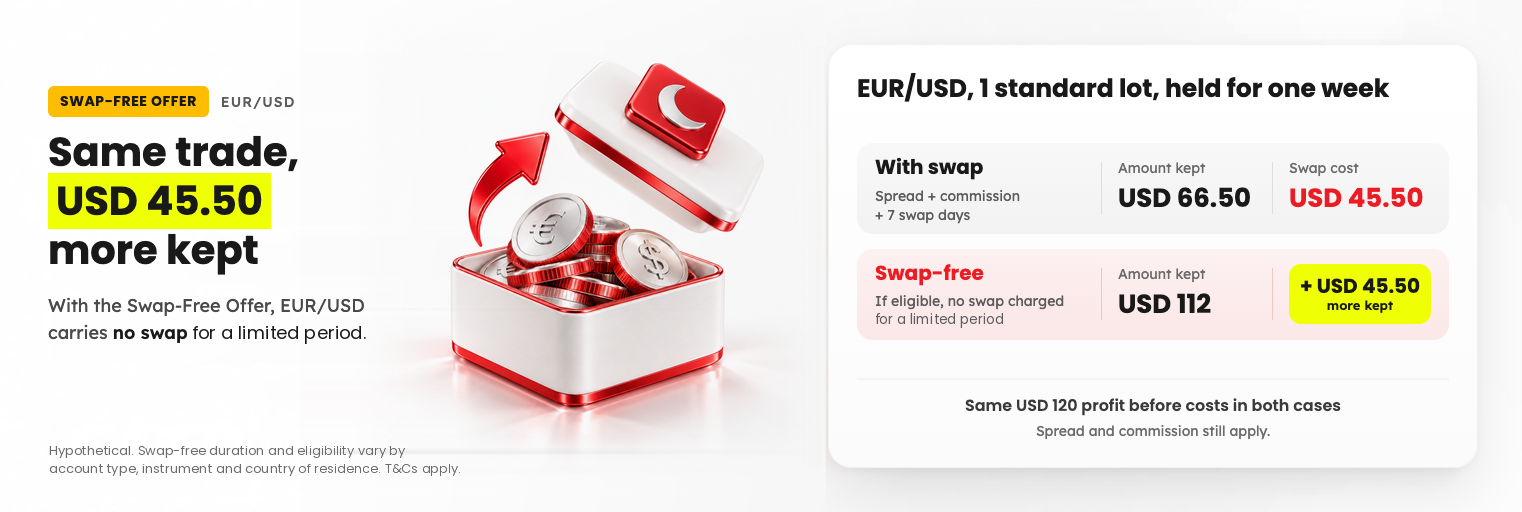
That is the practical value of reducing overnight financing: more of the favourable price move stays with you. Still, swap-free does not mean cost-free, since spreads and any commission still apply. And if a trade stays open beyond the applicable swap-free period, standard swap applies from that point on.
Above all, whichever account or offer you use, calculating costs beforehand tells you how far the market needs to move before the trade starts working for you.
Frequently Asked Questions
How Is Swap Calculated in Forex?
Swap = number of swap days × swap rate × lots × point value. For example, if one point is worth USD 1 per standard lot and the swap rate is −6.5 points, one swap day on one lot costs USD 6.50.
Why Is Swap Charged Three Times on Wednesday?
Because spot forex usually settles on a T+2 cycle, the Wednesday rollover covers the weekend for many forex pairs and carries three swap days at once. However, the triple swap day varies by instrument: on D Prime, it falls on Wednesday or Friday, depending on the symbol.
Do I Pay Swap If I Close Before Rollover?
Generally, no. Swap applies to positions that remain open through the daily rollover, although spread and any commission still apply to trades closed before it.
Can Forex Swap Be Positive?
Yes, depending on the currency pair, direction and financing rate, a position may receive a credit instead of a charge. Rates can change, however, so never assume a credit will continue.
Which Instruments Are Swap-Free With D Prime?
Under D Prime’s Swap-Free Offer, eligible Forex Majors, Forex Crosses and Forex Minors (excluding TRY pairs), Metals (including XAGUSD, excluding Special Metals), Oil and Natural Gas, and Spot Indices can be held swap-free for a limited period: 7 trading days for eligible standard clients, or up to 14 trading days for eligible VIP clients on application. For eligible clients residing in certain regions, the swap-free period is limited to 1 trading day. Cryptocurrencies, Futures CFDs, Stock CFDs, TRY pairs and Special Metals are not eligible. Both ECN and STP accounts qualify, while Cent and ECN Cent accounts are excluded. Swap-free duration and eligibility vary by account type, instrument and the client’s country of residence. Please refer to the latest Swap-Free Offer terms and conditions.
Risk Disclosure
Trading in Securities, Futures, contracts for difference (CFDs) and other financial products carries high risks due to the rapid and unpredictable fluctuations in the value and prices of these financial instruments. These fluctuations may result from adverse market movements, geopolitical events, economic data releases, and other unforeseen circumstances. You may sustain substantial losses, including losses exceeding your initial investment, within a short period of time.
Trading forex and CFDs on margin carries a high level of risk and may not be suitable for all investors. You are strongly advised to fully understand the nature and inherent risks of trading the respective financial instruments before engaging in any transactions with us. When you engage in transactions with D Prime, you acknowledge that you are aware of and accept these risks.
Disclaimer
The information contained herein is provided for general informational and educational purposes only and does not constitute investment advice, financial advice, trading advice or any other form of professional advice, a recommendation, or an offer or solicitation to buy or sell any financial instruments or engage in any trading strategy.
All examples in this article are hypothetical and provided for illustrative purposes only. They do not represent actual trading results or guarantee future performance. Spreads, swap rates, commissions and promotional terms may change from time to time. Please refer to the rates displayed on your trading platform and the latest applicable Terms and Conditions before trading.
Trading in leveraged products such as contracts for difference (CFDs) involves a significant risk of loss and may not be suitable for all investors. Past performance is not indicative of future results. Any information provided reflects the information available as at the date of publication and is subject to change without notice.
This article does not take into account any individual investor’s objectives, financial situation, or risk tolerance. Readers should conduct their own independent research and seek professional advice before making any investment or trading decisions. D Prime and its affiliates make no representations or warranties about the accuracy, completeness or reliability of this information and disclaim any and all liability for any direct, indirect, incidental, consequential, or other losses or damages arising out of or in connection with the use of or reliance on any information contained herein.
The above information should not be used or considered as the basis for any trading decisions or as an invitation to engage in any transaction. Do not rely on this article to replace your independent judgment.
“D Prime” is a brand name of D Prime Vanuatu Limited, a company incorporated and regulated by the Vanuatu Financial Services Commission (Company Number: 700238). The availability of products and services may vary depending on jurisdiction and applicable regulatory requirements. This content is intended for residents of jurisdictions where D Prime Vanuatu Limited is permitted to offer its products and services. It is not directed at, and must not be relied upon by, persons in jurisdictions where such offering would be contrary to local law or regulation.