

US Q2 GDP slowed to 1.5%, but resilient consumer spending and stronger domestic demand suggest recession fears may be overdone.
US growth looked disappointing at first glance.
On July 30, the US released its Q2 GDP data. Real GDP grew only 1.5% quarter over quarter, below the previous reading of 2.1% and the consensus estimate of 2.1%.
The headline looked worrying. Inflation pressure remains high, the US-Iran conflict has disrupted markets, and AI investment, one of the biggest growth engines in recent quarters, appears to be slowing.
But the deeper data tells a different story.
D Prime believes the US economy is weak on the surface, but sturdy underneath. The Q2 GDP miss should not be ignored, but it does not necessarily point to an imminent recession or stagflation shock.
For now, investors may continue to monitor market developments closely. D Prime still expects the Fed to deliver at most one rate hike in 2026.
Why Did US Q2 GDP Growth Slow?
The headline number was soft, but the weakness was not broad-based.
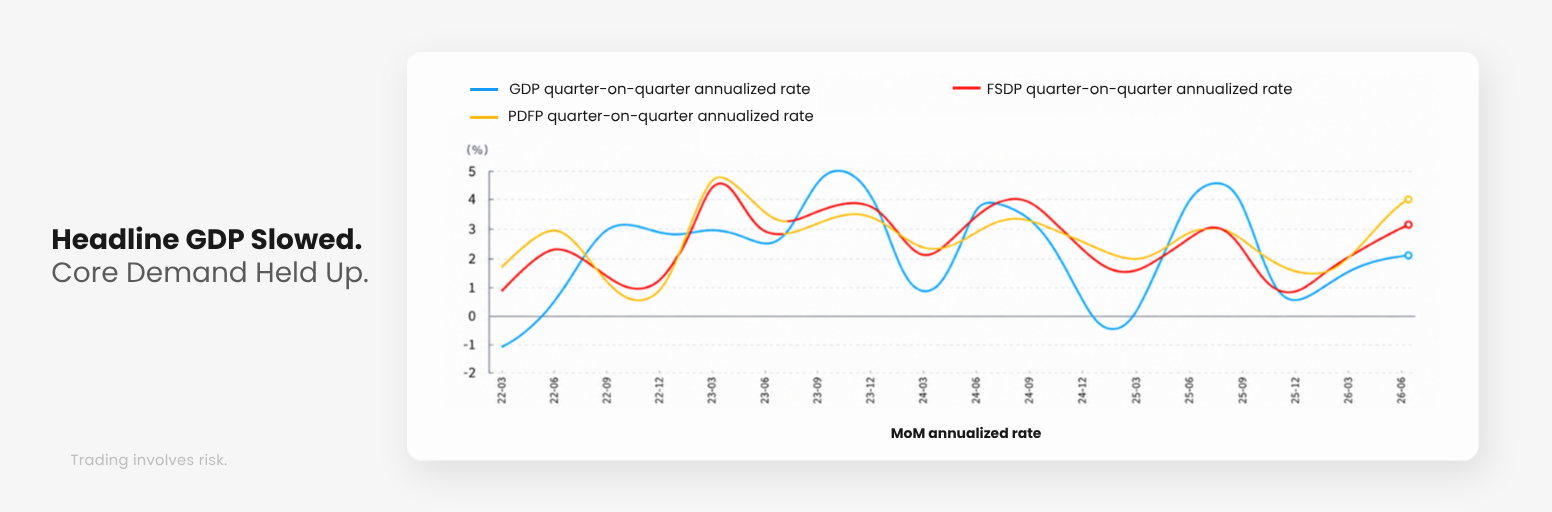
Private domestic final purchases, or PDFP, rose 3.9%, much higher than the previous reading of 1.7%. Final sales to domestic purchasers, or FSDP, which includes final demand from both the private and government sectors, also rose 3.1%.
This matters because PDFP and FSDP give a clearer picture of underlying domestic demand.
The main drags on Q2 GDP were net exports and government spending, not private demand.
The US has long run a trade deficit, so net exports often weigh on headline GDP. Weaker government spending also does not necessarily mean the private economy is collapsing.
In other words, the headline growth number looked weak, but the core demand structure was more resilient.
Consumer Spending Keeps the US Economy Supported
Consumption remains the main engine of US GDP.
In Q2, consumer spending rebounded strongly. Personal consumption growth rose from 0.5% to 3.2%, while its contribution to quarter-over-quarter GDP growth increased from 0.4 percentage points to 2.1 percentage points.
Most consumption categories improved, with the exception of housing. Entertainment and food services saw particularly strong growth, suggesting that consumers are still spending in areas linked to services and daily activity.
Still, there are questions about whether this rebound can last.
Part of the recovery may have been supported by short-term factors, including tax rebates from the One Big Beautiful Bill Act (OBBBA) and World Cup-related activity. Oil prices also remain high, and inflation has not fully returned to target. If energy costs stay elevated, household purchasing power could come under pressure again.
For now, however, the market remains relatively optimistic. Bloomberg forecasts US quarter-over-quarter GDP growth to stay around 2% in Q3 and Q4. The Federal Reserve Bank of Atlanta forecasts 4.95% quarter-over-quarter growth for Q3, while Bloomberg’s separate Q3 forecast stands at 3.29%.
That suggests investors do not yet see the Q2 GDP miss as the start of a major downturn.
Why AI Investment Slowed in Q2
AI investment cooled in Q2.
AI-related investment growth was as high as 34.4% in Q1 but slowed to 7.1% in Q2. Its contribution to GDP fell from 1.5 percentage points to 0.7 percentage points.
This slowdown matters because AI infrastructure spending has been supporting not only the US economy, but also parts of global growth.
However, the impact was not entirely negative.
As large-scale AI infrastructure construction cooled, US imports of raw materials and equipment also declined. That helped improve the net export contribution. Combined, AI investment and net exports contributed 1.2 percentage points to GDP, up from 0.5 percentage points previously.
So while AI investment slowed, the broader effect on GDP was more balanced than the headline suggests.
Trade and Government Spending Were the Main Drags
The two biggest drags on Q2 GDP were net exports and government spending.
Export growth slowed from 10.9% to 4.5%, while import growth reached 11.5%. This widened the trade drag on GDP.
Government spending also weakened, falling from 4.4% growth to -0.8%. The only area that increased was defense investment. Due to the US-Iran conflict, federal defense spending rose slightly, adding 0.23 percentage points.
This is why the GDP miss needs context.
The economy was not mainly dragged down by collapsing consumption or private demand. Instead, weakness came from categories that can fluctuate sharply: trade and government spending.
Are Consumer Credit Delinquencies a Recession Warning?
Consumer credit stress remains one of the market’s biggest concerns.
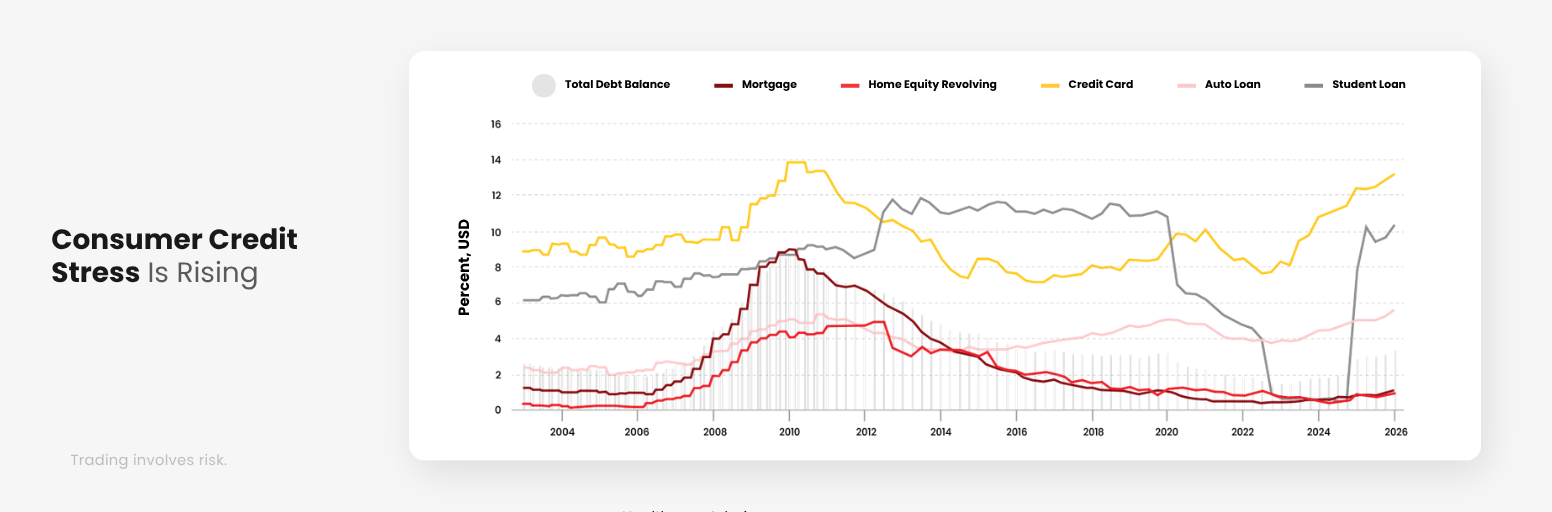
In Q1, data from the New York Fed showed that the 90+ day serious delinquency rate for US household consumer credit reached 3.36%, surpassing the 2019 peak.
Mortgage and auto loan delinquency rates reached 9.4% and 5.6%, respectively, while the credit card delinquency rate hit 13.12%.
At first glance, these numbers make the US economy look fragile. But D Prime believes investors do not need to overreact, as the broader economic fundamentals remain a key factor to consider.
One reason is methodology.
According to the New York Fed’s definition, loans that have already entered write-off or foreclosure status are still included in the statistics. If the impact of bad debt is stripped out, the delinquency rate has actually eased somewhat.
Another reason is timing.
Several previous preferential loan policies expired around the same period, creating a concentrated wave of delinquencies. For example, the end of the 2024 student loan forgiveness program pushed up student loan delinquency rates. This does not necessarily mean household finances are deteriorating sharply.
Auto Loans and Credit Cards Remain the Key Risks
The bigger risks are auto loans and credit card loans.
During the 2020 pandemic, US auto inventories collapsed. Short supply pushed up prices for both new and used cars. At the same time, the high-rate environment since 2022 raised financing costs.
As a result, the average monthly payment for new car loans from US auto finance companies rose from around USD 574 in Q1 2020 to USD 745 in Q4 2025, an increase of nearly 30%.
A key area to watch is BHPH, or Buy Here Pay Here.
BHPH is a model where used car dealers provide in-house financing to customers with weaker credit who may not qualify for traditional bank loans. The business has grown significantly in recent years, but it has also created a potential subprime-style risk in the auto sector.
To manage delinquency risk, BHPH lenders often require more frequent repayment schedules. Some borrowers must pay weekly or every two weeks, which increases the risk of technical delinquencies. Fed research shows that the 30+ day delinquency rate for BHPH auto loans is several times higher than that of traditional auto finance institutions.
Credit cards show a similar pattern. They are unsecured, have short repayment cycles, and put greater pressure on non-prime borrowers.
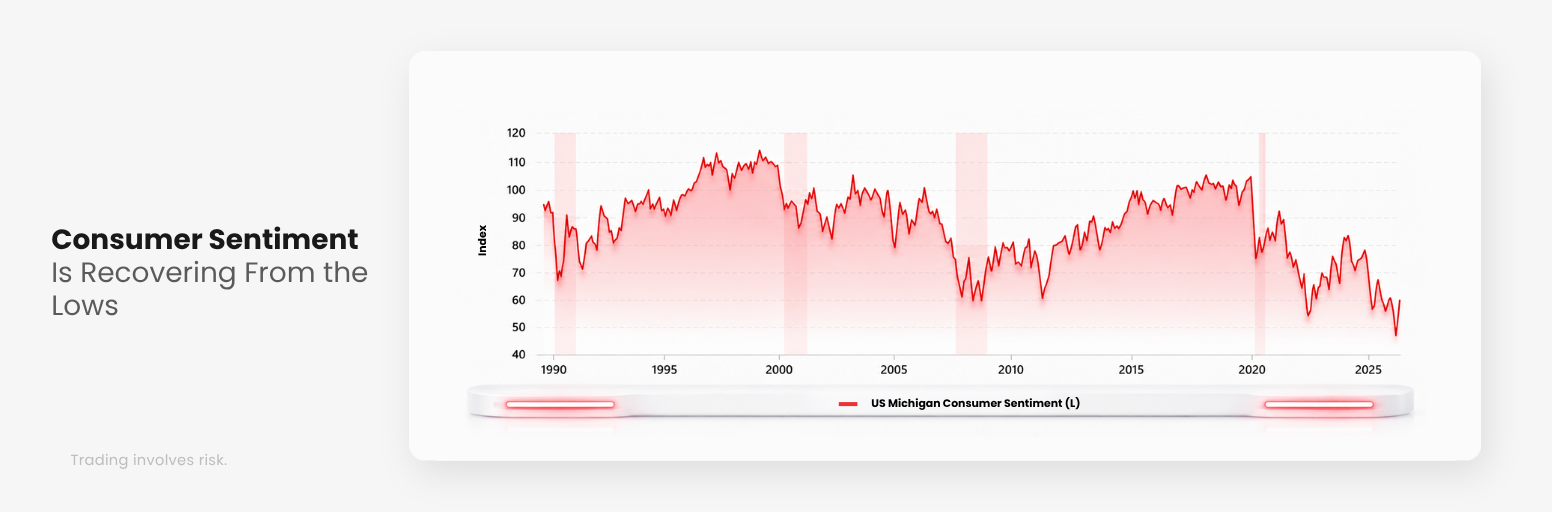
Overall, D Prime believes US consumption is weak, but it may have already bottomed. Many current delinquencies reflect technical or structural factors rather than a broad collapse in economic fundamentals.
What US Q2 GDP Means for Fed Rate-Hike Expectations
The next major question is whether the Fed will raise rates.
Based on Kevin Warsh’s recent statements, he remains focused on long-term Fed reforms and continues to emphasize zero tolerance for inflation. This means inflation remains the key variable for rate decisions.
However, cooling AI momentum may make the Fed more cautious about tightening too aggressively.
In the article “US June CPI Cools: Why Rate-Hike Fears May Still Be Overpriced,” D Prime argued that the Fed is unlikely to hike rates in Q3. The bond market has already delivered a de facto rate hike through higher yields, while US-Iran tensions have eased compared with earlier shock levels.
D Prime maintains the same view: the Fed is likely stay on hold in Q3, depending on incoming economic data and market developments.
The US labor market is weakening. Inflation is trending lower. Economic divergence is becoming more obvious. The real estate market remains sluggish. Under these conditions, a rate hike does not look appropriate.
At the same time, consumption remains resilient and inflation is still elevated, which makes a rate cut unlikely as well.
That leaves the Fed in wait-and-see mode.
The biggest variable is oil. Traders need to closely track changes in US-Iran relations and whether energy prices create another inflation shock.
What Slower GDP Growth Means for Tech Stocks and AI Markets
In the short term, growth stocks may face a broad correction.
Tech stocks are vulnerable to rate-hike concerns, weaker sentiment, and profit-taking after a strong AI-driven rally. If investors begin to question the sustainability of AI investment growth, volatility could increase.
However, D Prime remains constructive on the medium-term outlook.
The technology sector still has strong industry drivers and earnings support. At the same time, the Fed faces meaningful constraints when it comes to raising rates.
That means a tech-stock correction may create another investment opportunity rather than signal the end of the broader AI trend.
AI investment has slowed, but the long-term trend has not disappeared.
US Q2 GDP Shows Resilience Beneath the Headline
The Q2 GDP miss looks worrying on the surface, but it does not point to a collapsing US economy.
For traders, the bigger picture is still mixed: growth is slowing, but domestic demand remains resilient. Inflation is cooling, but not enough for rate cuts. AI investment has eased, but the long-term trend remains intact.
That keeps the Fed in wait-and-see mode.
D Prime expects the Fed to stay on hold in Q3, with oil prices and US-Iran tensions remaining the key risks to watch.
The US economy is not booming.
But it is not breaking either.
By D Prime Analysis Team
Macro and market strategy research by D Prime’s in-house analysis team.
Disclaimer
The information contained herein is provided for general informational and educational purposes only and does not constitute investment advice, financial advice, trading advice or any other form of professional advice, a recommendation, or an offer or solicitation to buy or sell any financial instruments or engage in any trading strategy.
Trading in leveraged products such as contracts for difference (CFDs) involves a significant risk of loss and may not be suitable for all investors. Past performance is not indicative of future results. Any references to market trends, asset performance, price levels, or forward-looking statements reflect opinions or general market commentary as at the date of publication and are subject to change without notice.
This article does not take into account any individual investor’s objectives, financial situation, or risk tolerance. Readers should conduct their own independent research and seek professional advice before making any investment or trading decisions. D Prime and its affiliates make no representations or warranties about the accuracy or completeness or reliability of this information and disclaim any and all liability for any direct, indirect, incidental, consequential, or other losses or damages arising out of or in connection with the use of or reliance on any information contained herein. The above information should not be used or considered as the basis for any trading decisions or as an invitation to engage in any transaction. Do not rely on this article to replace your independent judgment.
“D Prime” is a brand name of D Prime Vanuatu Limited, a company incorporated and regulated by the Vanuatu Financial Services Commission (Company Number: 700238). The availability of products and services may vary depending on jurisdiction and applicable regulatory requirements.