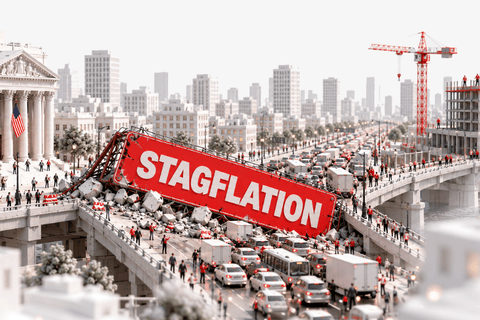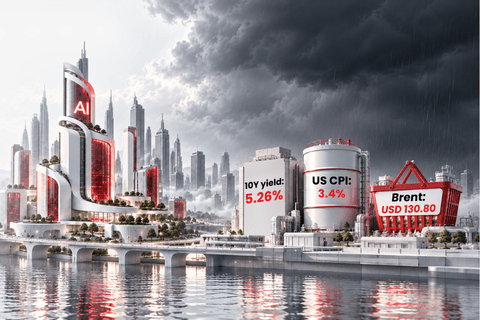


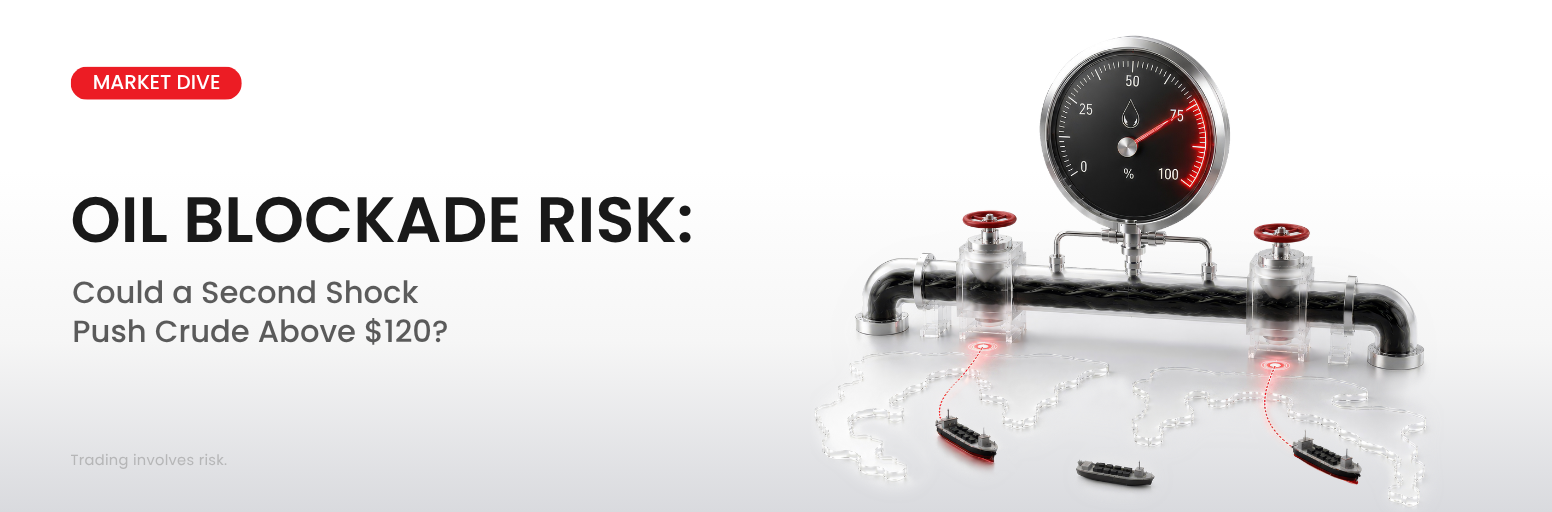
Oil Blockade Risk Is Back on the Market Radar
Oil risk is back in the spotlight.
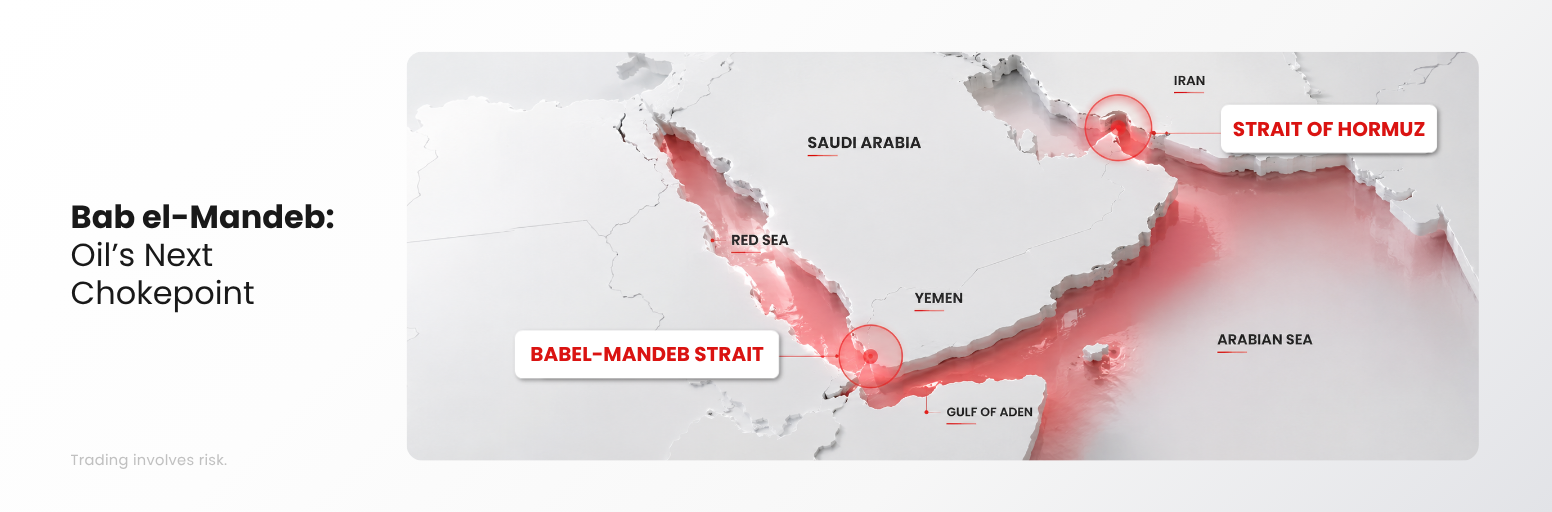
On July 23, Houthi forces in the Red Sea launched attacks on Saudi oil tankers. At the same time, the US-Iran situation remains unresolved, while another key oil shipping route, the Bab el-Mandeb Strait, is now facing renewed blockage risk.
By July 26, Brent crude surged to USD 100 per barrel. Some analysts believe that if both key straits remain blocked for an extended period, oil prices could climb back above USD 120.
Then sentiment shifted again.
After the US paused airstrikes on Iran, oil prices fell sharply when markets opened on July 27. Stock indices and gold rallied as risk appetite recovered.
But traders have seen this pattern before.
On-and-off clashes between the US and Iran have become the market’s new normal. The real question is not whether tensions will rise again. The real question is what happens if the agreement breaks down again, the Red Sea and Bab el-Mandeb Strait face fresh disruptions, and oil prices continue rising.
D Prime believes that if straits are blocked for a second time, the oil-price impact could be larger than the previous round.
That means traders should not ignore the risk.
Why the First Oil Blockade Had Limited Market Impact
The previous disruption can be seen as the first blockade, using the date when the US and Iran signed the memorandum of understanding as the cutoff point.
At that time, oil prices spiked toward USD 120 after the sudden outbreak of war. However, prices quickly fell back toward the USD 80 level after both sides signed the MOU.
Just as markets started to relax, clashes restarted in early July, pushing oil prices above USD 100 again.
Still, D Prime believes the first oil shock had a relatively limited market impact. That is one reason prices were able to fall back so quickly.
There were three major reasons.
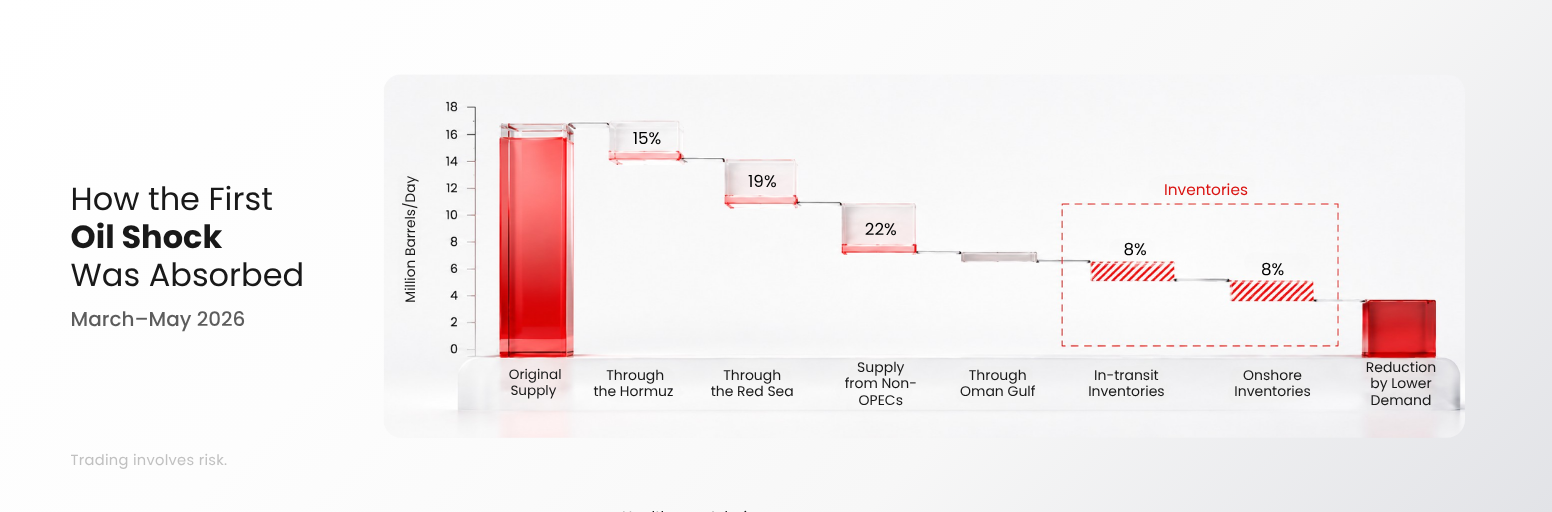
First, Gulf oil producers reacted quickly after the war broke out. The Red Sea shipping lane became an alternative route to the Strait of Hormuz, while countries also released emergency strategic petroleum reserves, or SPR, to offset the supply shortage caused by the war.
Between March and May, D Prime estimates that supply increased by around 9 million barrels per day, while reserve releases added another 3 million barrels per day. This helped ease the pressure and brought oil prices lower.
Second, high oil prices started to reduce demand. As prices rose sharply, some end users delayed demand, especially as supply-side disruptions affected refinery utilization and refined product availability.
Third, some major oil-demand countries, including China, have been accelerating the transition toward new energy. This reduced the direct impact of crude shortages compared with previous oil shocks.
By June, after the US and Iran agreed to a temporary ceasefire, traffic through the Strait of Hormuz had largely resumed. Oil exports passing through the strait recovered to 4.2 million barrels per day in June and reached 7.32 million barrels per day on July 2.
That was still only around 45% of the pre-war level, but it was enough to ease market panic.
Why the Second Shock Could Be Bigger
The first blockade was cushioned by emergency responses.
A second blockade may not be so easy to absorb.
Why were countries willing to tap their strategic petroleum reserves so quickly after the war started?
Because most expected the conflict to end quickly.
That assumption now looks less reliable.
On-and-off clashes have become the norm, and SPR inventories are not unlimited. Once reserves are used, they become harder to replace.
According to a report by Eastmoney Securities, this round of war has already reduced global inventories by around 1.5 billion barrels. Global crude inventories may fall further in the coming months and could reach an all-time low before the end of the year.
That changes the risk equation.
The crude supply chain has not truly recovered. In June, Gulf crude output increased by only 3.5 million barrels per day compared with the previous level of 20.0 million barrels per day.
In other words, the earlier decline in oil prices was not mainly driven by a full recovery in supply. It was largely supported by reserve releases.
That is a temporary fix, not a permanent solution.
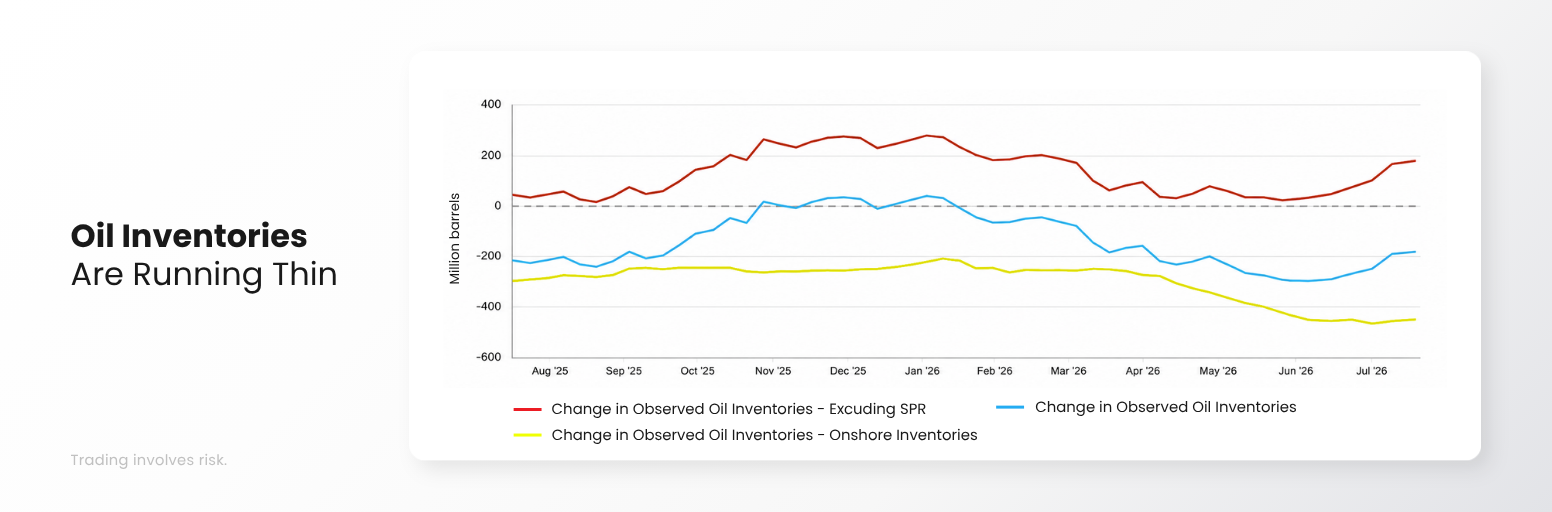
In July, global onshore oil inventories edged higher, but they remained below pre-war levels. Meanwhile, the number of days of supply in the US strategic petroleum reserve has also fallen to a low level.
US SPR inventories have dropped to 311 million barrels, a reduction of 104 million barrels since the war broke out. The remaining stock can only support releases of around 1 million barrels per day.
This is why a second blockade could be more damaging.
Bab el-Mandeb: The Chokepoint Traders Need to Watch
If both the Strait of Hormuz and Bab el-Mandeb Strait are disrupted, the demand gap could widen sharply. D Prime’s model suggests that a simultaneous blockage of both routes could push the supply gap from 3.5 million barrels per day in June to 6 million barrels per day.
Before Bab el-Mandeb is blocked, the Red Sea route can still carry around 3 million barrels per day of flow. But if Bab el-Mandeb also faces disruption, the shortage could become far more serious.
That is the risk markets may still be underpricing.
How Oil Blockade Risk Could Drive Inflation and Fed Rate-Hike Bets
Strait blockages do not only affect crude oil.
They can trigger ripple effects across the commodity market.
In April, D Prime published “Strait of Hormuz Closed Again: The Crisis Markets Ignore,” highlighting that helium, agricultural products, and other goods could also be affected by shipping disruptions.
Qatar accounts for around 34% of global helium supply, ranking second only to the US at 44% and far ahead of Russia at 10%.
Agricultural inputs are also exposed. Around 35% of urea and 30% of ammonia could face supply pressure, raising agricultural production costs and creating spillover inflation effects.
This raises an important question.
If inflation risk is so high, why has the stock market continued rising?
The answer is AI.
AI-related capital expenditure has helped offset the impact of higher oil prices. The market has been willing to look past inflation pressure because AI infrastructure investment has supported earnings expectations, especially in technology and semiconductor-related sectors.
But that support may be weakening.
As leading stocks such as Micron and SanDisk pull back, the current rally appears to have entered a correction phase. If oil prices rise again, AI infrastructure optimism may not support the stock market as strongly as it did during the previous blockade.
The market is already adjusting.
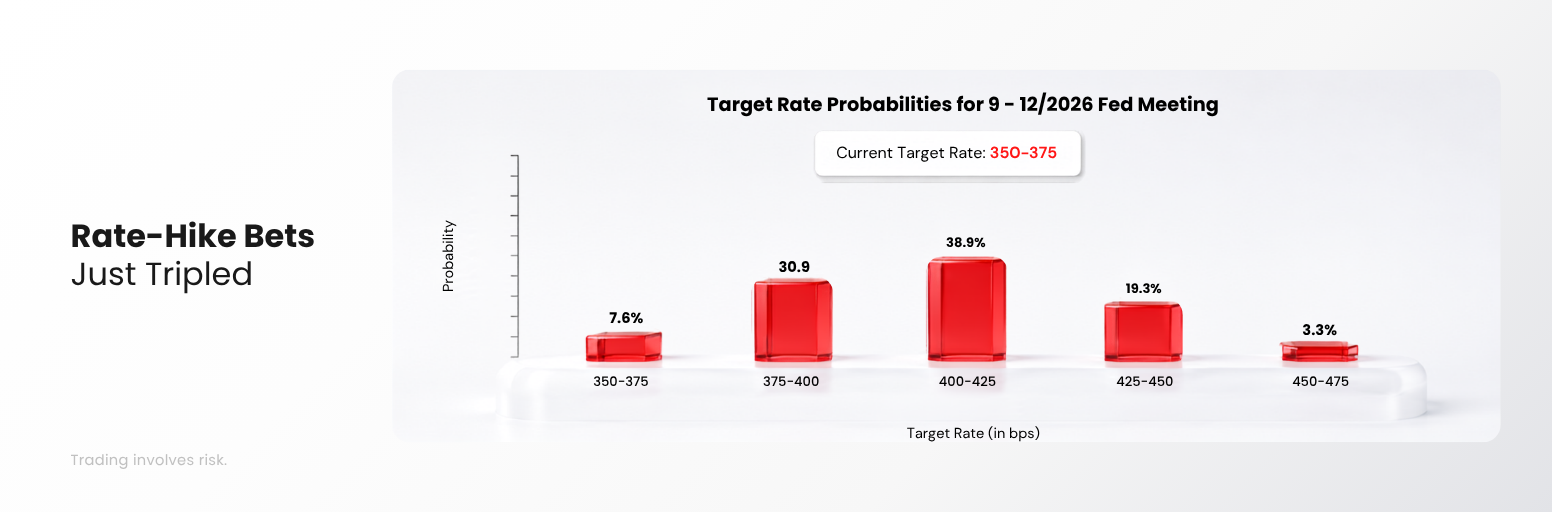
Currently, traders see only a 7.6% probability that the Fed will keep rates unchanged by December. A week earlier, that probability was 19.1%. In just one week, the market’s bet on a Fed rate hike tripled.
That shows how quickly oil risk can reshape rate expectations.
What Oil Blockade Risk Means for Gold and Silver
Interestingly, while the stock market has started to weaken, precious metals are showing signs of stabilization.
The AI hardware rally has pulled back sharply amid South Korea’s deleveraging and heavy selling at elevated levels. The Philadelphia Semiconductor Index fell significantly, causing capital to rotate back into the Magnificent 7 and other safer large-cap names.
Precious metals also benefited from this rotation.
Since July 17, spot gold has recovered from USD 3,959.8 to above USD 4,000, while silver has seen an even stronger rebound.
Why Precious Metals Are Stabilizing Despite a Strong Dollar
At first glance, this may look unusual.
Previously, due to the strength of the US dollar, gold was treated as an asset vulnerable to inflation fears. Whenever rate-hike expectations increased, gold and silver usually fell sharply.
So why are gold and silver rising as the probability of a second blockade increases?
D Prime believes the “strong dollar, weak gold” logic has not changed.
This gold rebound, like the Magnificent 7 rebound, may simply reflect capital rotation out of semiconductors rather than a major shift in the gold market itself.
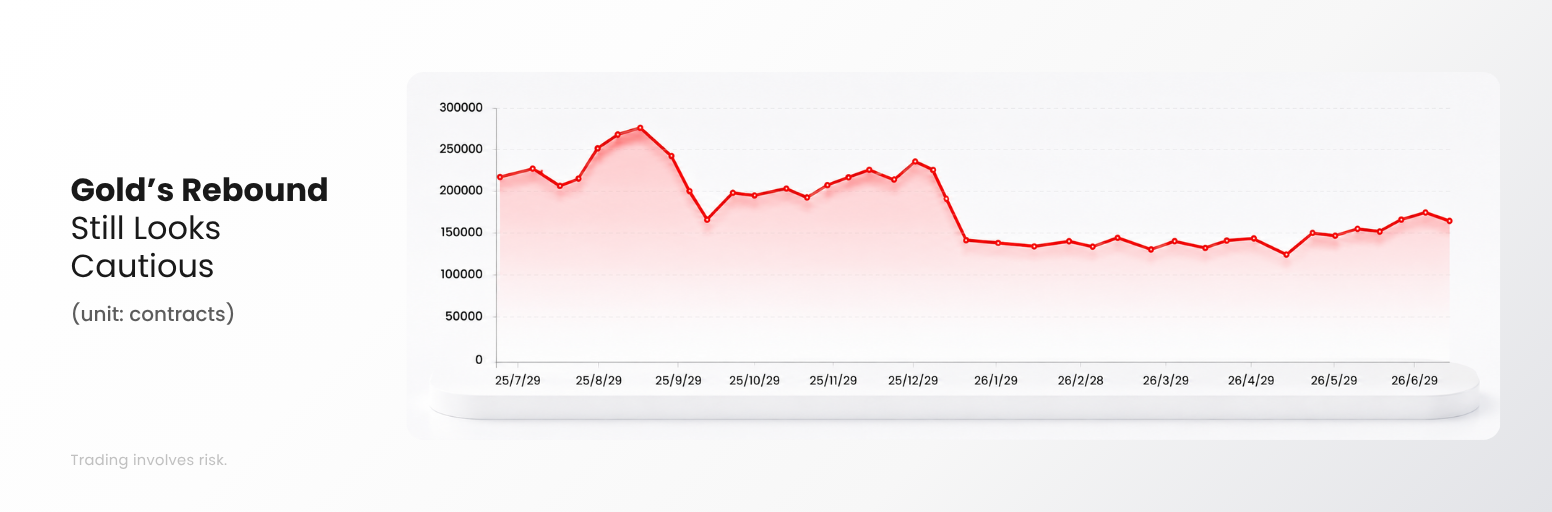
CFTC Comex gold non-commercial net positions also suggest that the rebound in gold futures positioning is not especially strong.
That means traders should be careful about treating the recent gold rebound as a full breakout signal.
This does not mean gold has no value.
A second blockade could trigger reflation, and the market reaction has confirmed D Prime’s earlier view: markets have become less sensitive to inflation shocks than before.
However, without a strong catalyst, precious metals may struggle to deliver large upside moves.
Gold and silver may still be suitable for allocation during corrections, especially when geopolitical risks, oil shocks, and market rotations create uncertainty.
But traders should avoid expecting explosive gains without a clear breakout catalyst.
In the current environment, precious metals look more like a defensive allocation than a high-conviction momentum trade.
Oil Blockade Risk Is Not Over
The first oil blockade did not break the market because emergency buffers worked.
Gulf producers raised output. Strategic reserves were released. Demand cooled. Alternative routes absorbed part of the pressure.
But those buffers are weaker now.
SPR inventories have fallen, global crude stocks remain tight, and the supply chain has not fully recovered. If both Hormuz and Bab el-Mandeb face renewed disruption, the second oil shock could be much harder to absorb.
For traders, the message is simple: oil risk is not over. A fresh blockade could lift inflation expectations, revive Fed rate-hike bets, pressure AI and semiconductor stocks, and support defensive rotation into gold and silver.
The market may be less sensitive to inflation than before, but it is not immune.
If oil shipping routes are disrupted again, the second shock could be bigger than the first.
By D Prime Analysis Team
Macro and market strategy research by D Prime’s in-house analysis team.
Disclaimer
The information contained herein is provided for general informational and educational purposes only and does not constitute investment advice, financial advice, trading advice or any other form of professional advice, a recommendation, or an offer or solicitation to buy or sell any financial instruments or engage in any trading strategy.
Trading in leveraged products such as contracts for difference (CFDs) involves a significant risk of loss and may not be suitable for all investors. Past performance is not indicative of future results. Any references to market trends, asset performance, price levels, or forward-looking statements reflect opinions or general market commentary as at the date of publication and are subject to change without notice.
This article does not take into account any individual investor’s objectives, financial situation, or risk tolerance. Readers should conduct their own independent research and seek professional advice before making any investment or trading decisions. D Prime and its affiliates make no representations or warranties about the accuracy or completeness or reliability of this information and disclaim any and all liability for any direct, indirect, incidental, consequential, or other losses or damages arising out of or in connection with the use of or reliance on any information contained herein. The above information should not be used or considered as the basis for any trading decisions or as an invitation to engage in any transaction. Do not rely on this article to replace your independent judgment.
“D Prime” is a brand name of D Prime Vanuatu Limited, a company incorporated and regulated by the Vanuatu Financial Services Commission (Company Number: 700238). The availability of products and services may vary depending on jurisdiction and applicable regulatory requirements.