


US Treasury yields remain high as term premium, fiscal risks and debt pressures rise. Could higher borrowing costs trigger a US debt crisis?
Something unusual is happening in the US Treasury market.
US economic growth slowed to an annualised 1.5% in Q2 2026, from 2.1% in Q1. July nonfarm payrolls fell by 23,000, while headline CPI eased to 3.4% year over year.
Normally, that combination should reduce pressure on long-term interest rates.
But it hasn’t.
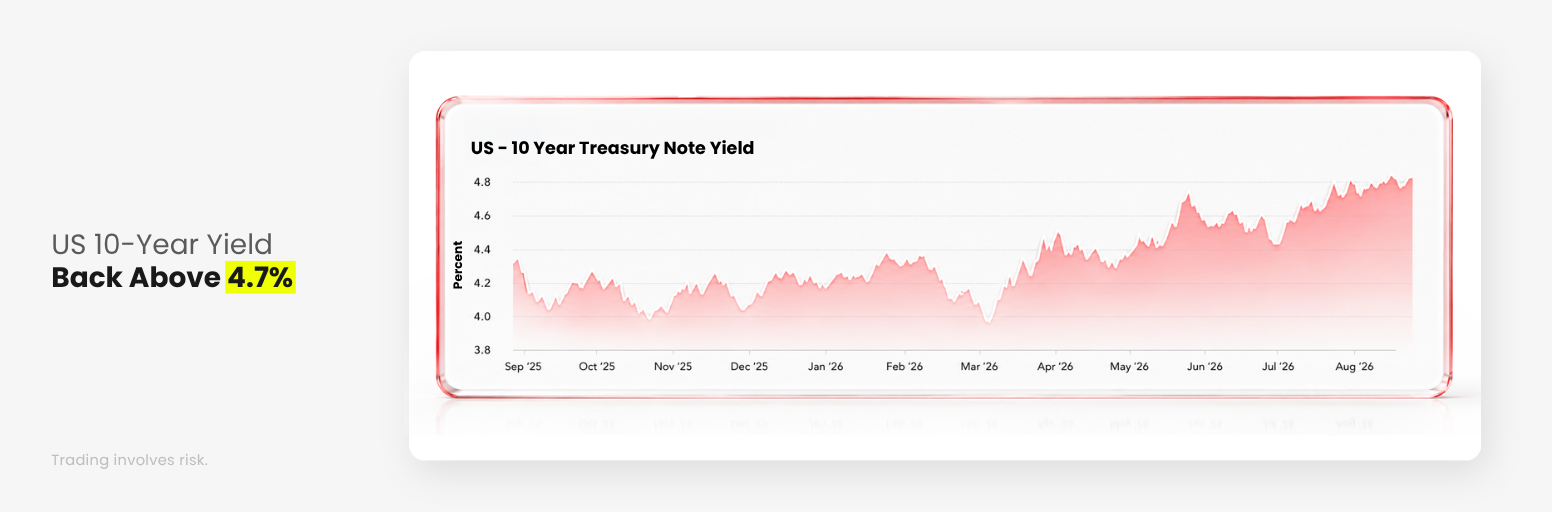
The 10-year US Treasury yield ended August around 4.75%, keeping borrowing costs near their highest levels since early 2025.
D Prime highlighted this tension in our previous analysis, “US Treasury Yields Spike: Why Buybacks May Not Stop the Bond Stress,” where we argued that Treasury Secretary Scott Bessent’s bond buyback strategy could help market liquidity, but would not remove the structural forces keeping long-term yields elevated.
The market is now showing exactly why.
The bigger risk may not be an imminent US debt crisis. Instead, the bond market is increasingly pointing to a prolonged period of higher-for-longer borrowing costs, as investors demand more compensation for fiscal risk, policy uncertainty and holding long-duration US debt.
So what is keeping Treasury yields high? And does this mean a US debt crisis is getting closer?
What Did Jackson Hole Change?
Fed Chair Kevin Warsh gave markets another reason to rethink the interest-rate outlook.
In his Jackson Hole address, Warsh maintained a hawkish stance, stressing that inflation remains above target while arguing that forward guidance should play a more limited role in normal times.
Markets reacted quickly.
CME market pricing pushed the probability of a September rate hike to around 57% following Warsh’s remarks, sharply higher than before Jackson Hole.
That matters because it added another layer of pressure to Treasury yields.
But Jackson Hole does not explain the whole story.
The Fed primarily influences expectations for future short-term interest rates. Long-term Treasury yields reflect something broader, including inflation expectations and the extra compensation investors demand for holding longer-duration debt.
That extra compensation is the term premium.
And it has been rising.
Why Are US Treasury Yields Staying High?
Three forces are working together.
The first is inflation risk.
Headline inflation has eased, but the Fed’s preferred PCE inflation measure remained elevated in July. Energy prices are also adding uncertainty. EIA data showed Brent crude averaging USD 94.20 per barrel in the week ending August 21, amid continued geopolitical tensions.
The second is Fed uncertainty.
Warsh has argued for limiting forward guidance, giving the Fed more flexibility but making the future rate path harder for markets to predict.
Less visibility means investors may demand more compensation for holding longer-duration Treasuries.
The third is fiscal pressure.
US gross federal debt has crossed USD 40 trillion, according to the Treasury’s Debt to the Penny database, while the government’s financing requirement remains substantial.
In May, Treasury estimated that it would need USD 671 billion in privately held net marketable borrowing during Q3.
By August, the Treasury had raised that estimate to USD 739 billion.
That matters because the market has to absorb that supply.
When Treasury issuance stays high while inflation, fiscal policy and Fed policy remain uncertain, investors can demand higher yields before committing capital.
That is where the term premium becomes particularly important.
Is the Term Premium Really Driving Yields Higher?
A long-term Treasury yield reflects several different forces:
- expected future short-term rates
- inflation expectations
- the term premium
The term premium is essentially the extra yield investors demand for holding longer-term debt rather than repeatedly investing in short-term bonds.
Recent data suggest that this premium has risen materially.
| Indicator | June 29 | August 21 | Change |
|---|---|---|---|
| 10-year Treasury yield | 4.38% | 4.74% | +36 bps |
| 10-year breakeven inflation | 2.22% | 2.34% | +12 bps |
| 10-year term premium* | 0.68% | 0.87% | +19 bps |
*Based on the Federal Reserve’s Kim-Wright term premium model. Term premium is model-estimated rather than directly observed.
The key point is that inflation expectations explain only part of the rise.
At the same time, the estimated term premium increased by roughly 19 basis points, suggesting investors are asking for more compensation for risks beyond inflation alone.
Those risks include fiscal uncertainty, Treasury supply, Fed policy uncertainty and the broader long-term outlook for US government finances.
This is the bigger change in the bond market.
The question is no longer simply whether inflation remains too high.
It is whether investors now need to be paid more to hold long-term US debt at all.
How Serious Is the US Debt Problem?
The headline number is large, but the more important issue is how higher rates interact with that debt.
According to the CBO, gross federal debt was around 123% of GDP in 2025, while debt held by the public reached 99.8% of GDP.
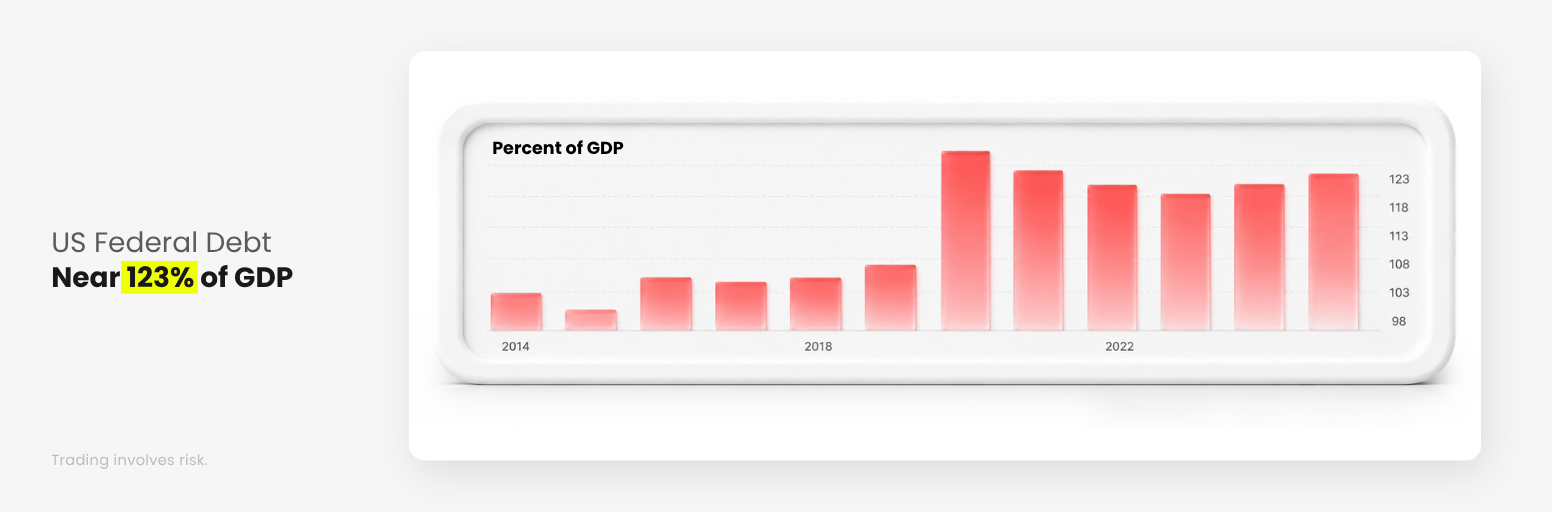
At the same time, US government net interest costs reached USD 970 billion in fiscal 2025, more than twice their share of GDP in 2021.
That is where higher Treasury yields become more important.
Not all government debt reprices immediately. But as older debt matures, it has to be refinanced at current market rates.
This creates a difficult feedback loop:
higher debt leads to more financing needs
more financing increases Treasury supply
greater supply can require higher yields
higher yields increase interest expenses
and higher interest expenses make future deficits harder to reduce
That does not automatically create a debt crisis.
But it does make the fiscal system increasingly sensitive to elevated interest rates.
Why Hasn’t a US Debt Crisis Happened Yet?
Because the US still has advantages that few other countries have.
The dollar remains central to global trade and finance, while the Treasury market remains one of the deepest and most liquid pools of government debt in the world.
That creates structural demand for US assets.
Investors are also not abandoning Treasuries.
According to the Congressional Budget Office’s 2026 outlook, of the USD 30.2 trillion in federal debt held by the public at the end of fiscal 2025, roughly 70% was held by domestic entities and 30% by foreign investors.
The more important question is therefore not whether investors will stop buying Treasuries.
It is:
What yield will they demand to keep buying them?
That is why the term premium matters so much.
A debt market does not need to collapse for fiscal pressure to become a problem.
Investors can simply demand higher compensation.
Is a US Debt Crisis Really Coming?
Ray Dalio remains one of the most prominent voices warning about the long-term consequences of US debt accumulation.
D Prime does not see an imminent US debt crisis as the base case.
The dollar remains deeply embedded in global finance. The Treasury market is still highly liquid, and the US government retains significant flexibility over debt issuance and maturity management.
But those advantages do not make the US immune to rising borrowing costs.
The more realistic near-term risk may be much less dramatic than a sudden default.
Instead, Treasury yields could simply remain structurally higher.
That would keep mortgage rates elevated.
Corporate refinancing would stay expensive.
Higher discount rates could pressure equity valuations.
And the government would need to devote an increasingly large share of revenue to interest payments.
In other words, the risk may not be an immediate debt crisis.
It may be a prolonged period in which the world’s benchmark borrowing rate becomes more expensive.
What Do Higher Treasury Yields Mean for the Dollar and Gold?
The relationship between Treasury yields and the dollar has become increasingly important.
Normally, higher US yields support the dollar by making dollar-denominated assets more attractive.
But during August, the dollar remained relatively weak even as long-term Treasury yields stayed elevated.
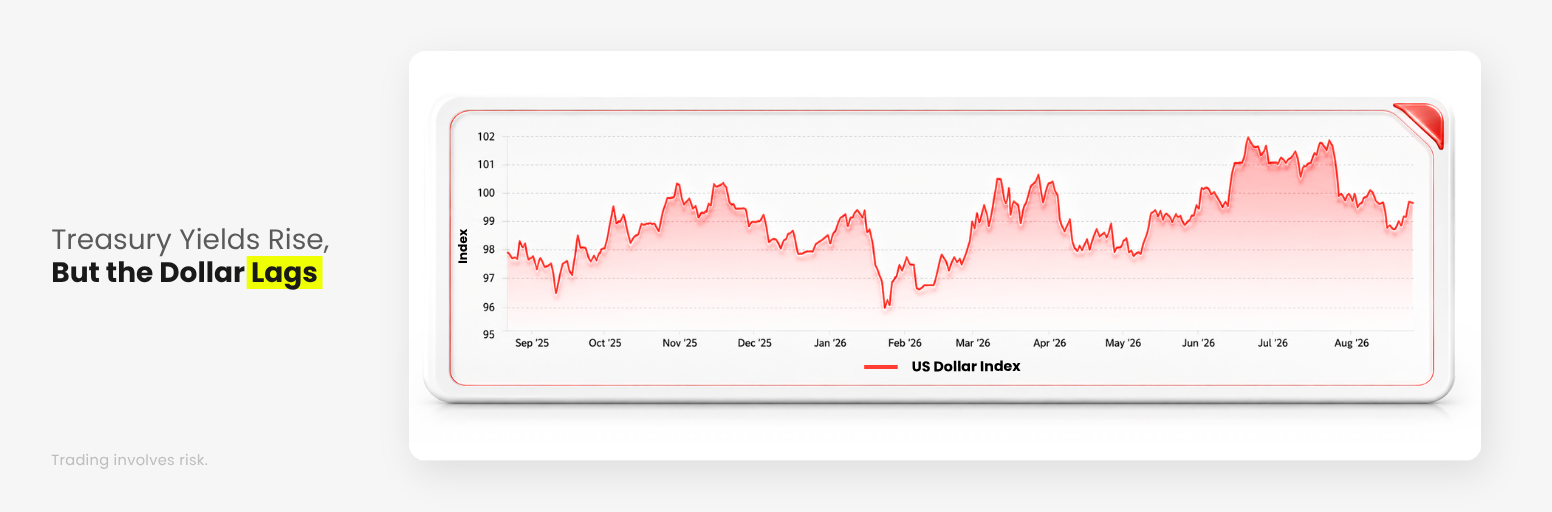
That divergence suggested that at least part of the yield move was being driven by a higher risk premium rather than stronger economic growth alone.
More recently, the dollar has strengthened again as markets increased expectations for a September Fed hike.
That distinction matters.
When yields rise because markets expect tighter Fed policy, the dollar can benefit.
When yields rise because investors demand more compensation for fiscal or long-duration risk, dollar support may be weaker.
Gold faces the opposite tension.
Higher Treasury yields increase the opportunity cost of holding a non-yielding asset, which can limit gold’s upside in the short term.
But the same forces pushing the term premium higher, including fiscal uncertainty, geopolitical risk and questions around long-term dollar credibility, can also support safe-haven demand.
Gold is therefore caught between two competing forces:
high yields above, structural uncertainty below.
What Should Traders Watch Next?
The 10-year yield alone no longer tells the full story.
Watch the 2-year versus the 10-year. The 2-year is more sensitive to Fed expectations, while the 10-year captures a broader mix of inflation, policy and long-term risk.
Watch Treasury borrowing and auctions. Treasury has already lifted its Q3 borrowing estimate to USD 739 billion. Auction demand will show how easily markets are absorbing that supply.
Watch the yield-dollar relationship. If Treasury yields rise while the dollar struggles, it may signal that risk-premium concerns are becoming more important.
Watch oil and gold. Energy prices can quickly change inflation expectations, while gold remains highly sensitive to both real yields and fiscal uncertainty.
What Is the Bond Market Really Telling Us?
The US Treasury market is not necessarily signalling that a debt crisis is about to begin.
But it is sending a clear message.
Investors are demanding more compensation to hold long-term US government debt.
Part of that reflects inflation.
Part reflects expectations for Fed policy.
But the rise in term premium shows that uncertainty itself is increasingly being priced.
With federal debt above USD 40 trillion, Treasury borrowing still rising and interest costs approaching USD 1 trillion a year, that uncertainty is unlikely to disappear quickly.
The bigger risk may therefore be less dramatic than a sudden US debt crisis, but much more persistent:
a world in which US Treasury yields simply stay higher for longer.
By D Prime Analysis Team
Macro and market strategy research by D Prime’s in-house analysis team.
Disclaimer
The information contained herein is provided for general informational and educational purposes only and does not constitute investment advice, financial advice, trading advice or any other form of professional advice, a recommendation, or an offer or solicitation to buy or sell any financial instruments or engage in any trading strategy.
Trading in leveraged products such as contracts for difference (CFDs) involves a significant risk of loss and may not be suitable for all investors. Past performance is not indicative of future results. Any references to market trends, asset performance, price levels, or forward-looking statements reflect opinions or general market commentary as at the date of publication and are subject to change without notice.
This article does not take into account any individual investor’s objectives, financial situation, or risk tolerance. Readers should conduct their own independent research and seek professional advice before making any investment or trading decisions. D Prime and its affiliates make no representations or warranties about the accuracy or completeness or reliability of this information and disclaim any and all liability for any direct, indirect, incidental, consequential, or other losses or damages arising out of or in connection with the use of or reliance on any information contained herein. The above information should not be used or considered as the basis for any trading decisions or as an invitation to engage in any transaction. Do not rely on this article to replace your independent judgment.
“D Prime” is a brand name of D Prime Vanuatu Limited, a company incorporated and regulated by the Vanuatu Financial Services Commission (Company Number: 700238). The availability of products and services may vary depending on jurisdiction and applicable regulatory requirements.